
Size Exclusion Chromatography Analysis with measure.sec
Source:vignettes/sec-analysis.Rmd
sec-analysis.RmdIntroduction
Size Exclusion Chromatography (SEC), also known as Gel Permeation Chromatography (GPC), is a fundamental technique for characterizing the molecular weight distribution of polymers, proteins, and other macromolecules. The measure.sec package extends the measure package with specialized preprocessing steps for SEC/GPC data analysis. This vignette demonstrates how to:
- Process multi-detector SEC data (RI, UV/DAD, MALS, LALS, RALS, DLS)
- Calculate molecular weight averages and distributions
- Analyze copolymer composition
- Quantify protein aggregates
- Perform quality control checks
Setup
library(measure)
#> Loading required package: recipes
#> Loading required package: dplyr
#>
#> Attaching package: 'dplyr'
#> The following objects are masked from 'package:stats':
#>
#>     filter, lag
#> The following objects are masked from 'package:base':
#>
#>     intersect, setdiff, setequal, union
#>
#> Attaching package: 'recipes'
#> The following object is masked from 'package:stats':
#>
#>     step
library(measure.sec)
library(recipes)
library(dplyr)
library(tidyr)
library(purrr)
library(ggplot2)
The measure.sec Data Model
The package uses the measure framework, where
chromatographic signals are stored as nested tibbles. Each sample has a
measure_tbl containing:
-
location: Elution time or volume -
value: Detector response
Multiple samples are combined into a measure_list
column.
Example Dataset
The package includes sec_triple_detect, a synthetic
dataset representing multi-detector SEC analysis:
data(sec_triple_detect, package = "measure.sec")

# Overview of the dataset
glimpse(sec_triple_detect)
#> Rows: 24,012
#> Columns: 11
#> $ sample_id        <chr> "PS-1K", "PS-1K", "PS-1K", "PS-1K", "PS-1K", "PS-1K",…
#> $ sample_type      <chr> "standard", "standard", "standard", "standard", "stan…
#> $ polymer_type     <chr> "polystyrene", "polystyrene", "polystyrene", "polysty…
#> $ elution_time     <dbl> 5.00, 5.01, 5.02, 5.03, 5.04, 5.05, 5.06, 5.07, 5.08,…
#> $ ri_signal        <dbl> 6.926392e-04, 0.000000e+00, 3.199253e-04, 4.197175e-0…
#> $ uv_signal        <dbl> 0.0002034583, 0.0000000000, 0.0000000000, 0.000000000…
#> $ mals_signal      <dbl> 3.370385e-05, 3.483481e-05, 3.102092e-05, 3.261962e-0…
#> $ known_mw         <dbl> 1000, 1000, 1000, 1000, 1000, 1000, 1000, 1000, 1000,…
#> $ known_dispersity <dbl> 1.05, 1.05, 1.05, 1.05, 1.05, 1.05, 1.05, 1.05, 1.05,…
#> $ dn_dc            <dbl> 0.185, 0.185, 0.185, 0.185, 0.185, 0.185, 0.185, 0.18…
#> $ extinction_coef  <dbl> 1.2, 1.2, 1.2, 1.2, 1.2, 1.2, 1.2, 1.2, 1.2, 1.2, 1.2…

# Sample types included
sec_triple_detect |>
  distinct(sample_id, sample_type, polymer_type) |>
  print(n = 12)
#> # A tibble: 12 × 3
#>    sample_id sample_type polymer_type
#>    <chr>     <chr>       <chr>
#>  1 PS-1K     standard    polystyrene
#>  2 PS-10K    standard    polystyrene
#>  3 PS-50K    standard    polystyrene
#>  4 PS-100K   standard    polystyrene
#>  5 PS-500K   standard    polystyrene
#>  6 PMMA-Low  sample      pmma
#>  7 PMMA-Med  sample      pmma
#>  8 PMMA-High sample      pmma
#>  9 PEG-5K    sample      peg
#> 10 PEG-20K   sample      peg
#> 11 Copoly-A  sample      copolymer
#> 12 Copoly-B  sample      copolymer
Basic Workflow: Single Detector Analysis
Let’s start with a simple RI detector workflow for polystyrene standards:
# Filter to PS standards
ps_standards <- sec_triple_detect |>
  filter(polymer_type == "polystyrene")

# Create the preprocessing recipe
# Note: The formula specifies which columns to use and sample_id as grouping
rec <- recipe(
  ri_signal + elution_time + dn_dc ~ sample_id,
  data = ps_standards
) |>
  update_role(sample_id, new_role = "id") |>
  # Convert to measure format
  step_measure_input_long(
    ri_signal,
    location = vars(elution_time),
    col_name = "ri"
  ) |>
  # Apply baseline correction
  step_sec_baseline(measures = "ri") |>
  # Process RI detector with dn/dc
  step_sec_ri(measures = "ri", dn_dc_column = "dn_dc")

# Prep and bake
prepped <- prep(rec)
result <- bake(prepped, new_data = NULL)

# View RI signal results (MW calculation requires calibration - see below)
result |>
  select(sample_id, ri)
#> # A tibble: 5 × 2
#>   sample_id          ri
#>   <chr>          <meas>
#> 1 PS-1K     [2,001 × 2]
#> 2 PS-10K    [2,001 × 2]
#> 3 PS-50K    [2,001 × 2]
#> 4 PS-100K   [2,001 × 2]
#> 5 PS-500K   [2,001 × 2]
Conventional Calibration
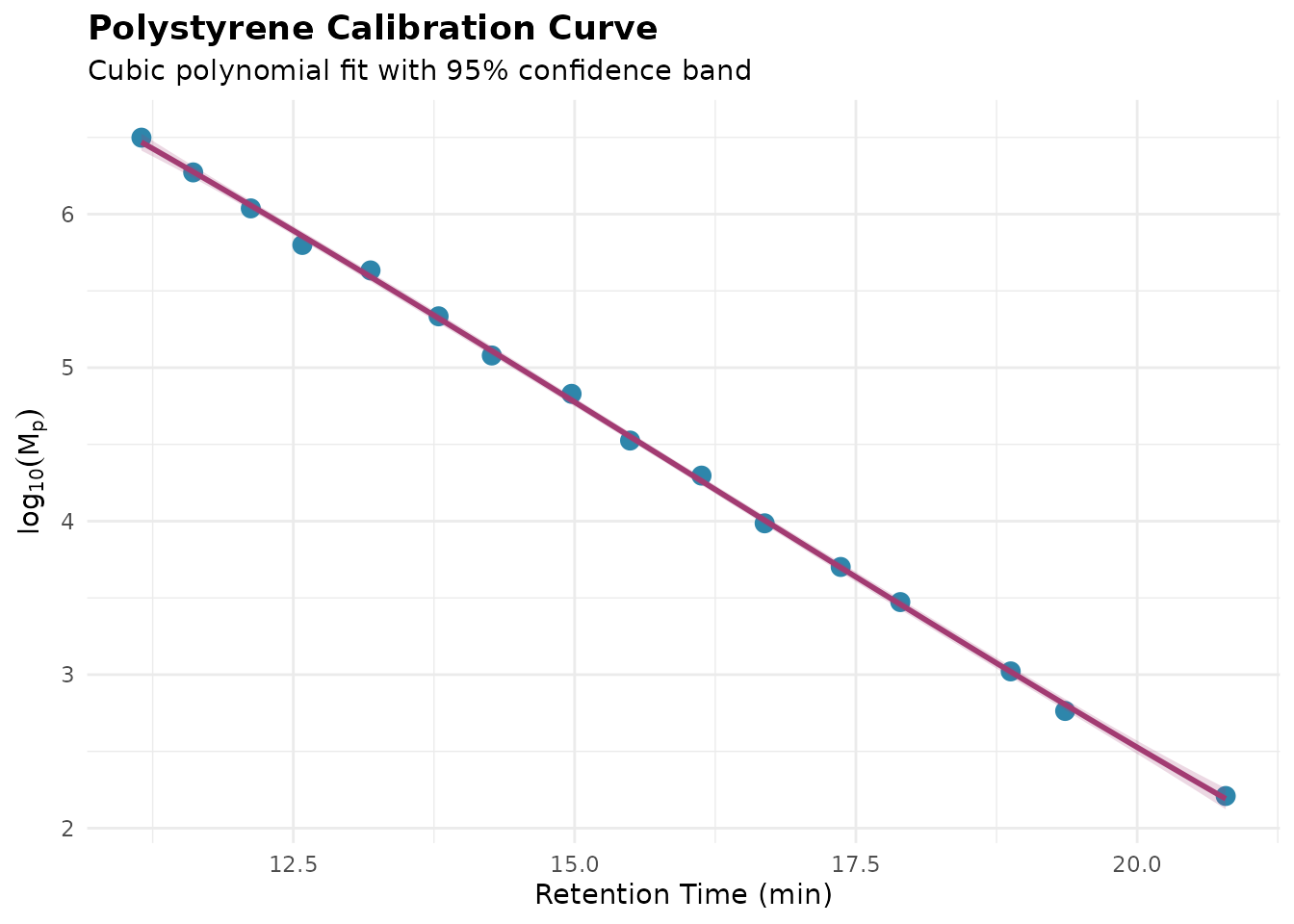
Conventional (relative) calibration uses narrow molecular weight standards to establish the relationship between elution time and molecular weight. This is the most common approach for routine polymer analysis.
Calibration Standards
The package includes comprehensive polystyrene and PMMA calibration standards:
# Load polystyrene calibration standards
data(sec_ps_standards, package = "measure.sec")

# View the standards (16 standards from 162 Da to 3.15 MDa)
sec_ps_standards |>
  select(standard_name, mp, log_mp, retention_time, dispersity) |>
  print(n = 8)
#> # A tibble: 16 × 5
#>   standard_name      mp log_mp retention_time dispersity
#>   <chr>           <dbl>  <dbl>          <dbl>      <dbl>
#> 1 PS-3150000    3150000   6.50           11.2       1.04
#> 2 PS-1870000    1870000   6.27           11.6       1.04
#> 3 PS-1090000    1090000   6.04           12.1       1.03
#> 4 PS-630000      630000   5.80           12.6       1.04
#> 5 PS-430000      430000   5.63           13.2       1.04
#> 6 PS-216000      216000   5.33           13.8       1.03
#> 7 PS-120000      120000   5.08           14.3       1.03
#> 8 PS-67500        67500   4.83           15.0       1.03
#> # ℹ 8 more rows
Visualizing the Calibration Curve
Before fitting, it’s good practice to visualize the standards:
ggplot(sec_ps_standards, aes(retention_time, log_mp)) +
  geom_point(size = 3, color = "#2E86AB") +
  geom_smooth(
    method = "lm",
    formula = y ~ poly(x, 3),
    se = TRUE,
    color = "#A23B72",
    fill = "#A23B72",
    alpha = 0.2
  ) +
  labs(
    x = "Retention Time (min)",
    y = expression(log[10](M[p])),
    title = "Polystyrene Calibration Curve",
    subtitle = "Cubic polynomial fit with 95% confidence band"
  ) +
  theme_minimal() +
  theme(
    plot.title = element_text(face = "bold"),
    axis.title = element_text(size = 11)
  )
Building a Calibration Curve
Use step_sec_conventional_cal() to fit the calibration
and apply it to samples.
step_sec_conventional_cal()
Parameters:
| Parameter | Type | Default | Description |
|---|---|---|---|
measures |
character | — | Column(s) containing measure data |
standards |
data.frame | — | Calibration standards with retention and
log_mw columns |
fit_type |
character | "cubic" |
Polynomial fit: "linear", "quadratic",
"cubic", "quartic"
|
output_col |
character | NULL |
Name for MW output column (or NULL to modify in
place) |
extrapolation |
character | "warn" |
Handle values outside calibration: "none",
"warn", "allow"
|
log_transform |
logical | TRUE |
Whether standards use log10(MW) |
# Prepare standards for the step (needs 'retention' and 'log_mw' columns)
ps_cal <- sec_ps_standards |>
  select(retention = retention_time, log_mw = log_mp)

# Filter to a polystyrene sample for demonstration
ps_sample <- sec_triple_detect |>
  filter(sample_id == "PS-50K")

# Build the calibration recipe
# Note: Use explicit formula with sample_id as the grouping variable
rec_cal <- recipe(
  ri_signal + elution_time + dn_dc ~ sample_id,
  data = ps_sample
) |>
  update_role(sample_id, new_role = "id") |>
  step_measure_input_long(
    ri_signal,
    location = vars(elution_time),
    col_name = "ri"
  ) |>
  step_sec_baseline(measures = "ri") |>
  # Apply calibration to convert elution time to log(MW)
  step_sec_conventional_cal(
    measures = "ri",
    standards = ps_cal,
    fit_type = "cubic",
    output_col = "mw",
    extrapolation = "none"
  ) |>
  # Calculate MW averages from RI signal weighted by MW
  step_sec_mw_averages(measures = "ri")

# Prep and bake
prepped <- prep(rec_cal)
#> Warning: Standard at 12.58 has 14.4% MW deviation.
#> ℹ Consider removing outlier standards or using a different fit type.
result <- bake(prepped, new_data = NULL)

# View molecular weight results
result |>
  select(sample_id, mw_mn, mw_mw, mw_mz, mw_dispersity)
#> # A tibble: 1 × 5
#>   sample_id      mw_mn   mw_mw   mw_mz mw_dispersity
#>   <chr>          <dbl>   <dbl>   <dbl>         <dbl>
#> 1 PS-50K    419927756. 8.24e21 7.81e23       1.96e13
Assessing Calibration Quality
The tidy() method provides comprehensive diagnostics for
evaluating calibration quality:
# Get calibration diagnostics
diagnostics <- tidy(prepped, number = 3)  # step_sec_conventional_cal is step 3

# Overview metrics
diagnostics |>
  select(fit_type, n_standards, r_squared, rmse_log_mw, max_abs_pct_deviation)
#> # A tibble: 1 × 5
#>   fit_type n_standards r_squared rmse_log_mw max_abs_pct_deviation
#>   <chr>          <int>     <dbl>       <dbl>                 <dbl>
#> 1 cubic             16     0.999      0.0294                  14.4

# Access per-standard residuals
std_results <- diagnostics$standard_results[[1]]
std_results |>
  select(
    location,
    actual_log_mw,
    predicted_log_mw,
    residual_log_mw,
    pct_deviation
  )
#> # A tibble: 16 × 5
#>    location actual_log_mw predicted_log_mw residual_log_mw pct_deviation
#>       <dbl>         <dbl>            <dbl>           <dbl>         <dbl>
#>  1     11.2          6.50             6.47         0.0294         -6.55
#>  2     11.6          6.27             6.28        -0.00364         0.841
#>  3     12.1          6.04             6.06        -0.0192          4.51
#>  4     12.6          5.80             5.86        -0.0585         14.4
#>  5     13.2          5.63             5.59         0.0421         -9.24
#>  6     13.8          5.33             5.32         0.0126         -2.87
#>  7     14.3          5.08             5.11        -0.0300          7.15
#>  8     15.0          4.83             4.79         0.0413         -9.07
#>  9     15.5          4.53             4.55        -0.0262          6.22
#> 10     16.1          4.30             4.26         0.0352         -7.78
#> 11     16.7          3.99             4.01        -0.0197          4.63
#> 12     17.4          3.70             3.70         0.00359        -0.823
#> 13     17.9          3.47             3.46         0.0146         -3.31
#> 14     18.9          3.02             3.02         0.00222        -0.511
#> 15     19.4          2.76             2.81        -0.0419         10.1
#> 16     20.8          2.21             2.19         0.0181         -4.07
Key quality metrics:
| Metric | Good Value | Description |
|---|---|---|
| R² | > 0.999 | Coefficient of determination |
| RMSE | < 0.02 | Root mean square error in log(MW) |
| Max % Deviation | < 5% | Largest deviation at any standard |
| Dispersity | < 1.10 | Standards should be narrow |
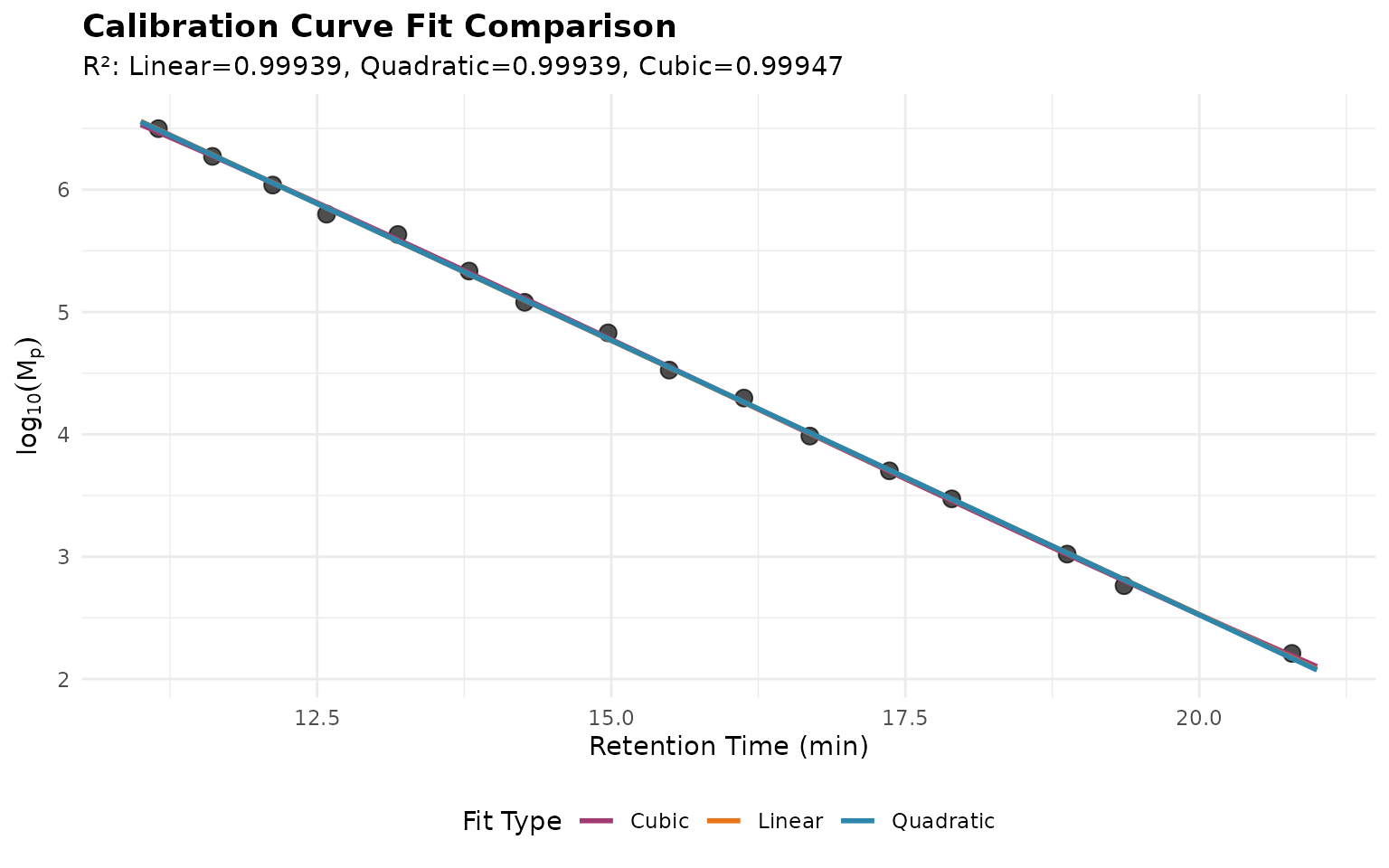
Comparing Fit Types
Different polynomial orders may be appropriate depending on column behavior:
# Compare linear, quadratic, and cubic fits
library(tidyr)

fits <- tibble(
  fit_type = c("Linear", "Quadratic", "Cubic"),
  degree = c(1, 2, 3)
) |>
  mutate(
    predictions = map(degree, function(d) {
      model <- lm(log_mp ~ poly(retention_time, d), data = sec_ps_standards)
      tibble(
        retention_time = seq(11, 21, by = 0.1),
        log_mp = predict(model, newdata = tibble(retention_time = seq(11, 21, by = 0.1)))
      )
    }),
    r_squared = map_dbl(degree, function(d) {
      model <- lm(log_mp ~ poly(retention_time, d), data = sec_ps_standards)
      summary(model)$r.squared
    })
  )

fit_curves <- fits |>
  unnest(predictions)

ggplot() +
  geom_point(
    data = sec_ps_standards,
    aes(retention_time, log_mp),
    size = 3,
    alpha = 0.7
  ) +
  geom_line(
    data = fit_curves,
    aes(retention_time, log_mp, color = fit_type),
    linewidth = 1
  ) +
  scale_color_manual(
    values = c("Linear" = "#E8751A", "Quadratic" = "#2E86AB", "Cubic" = "#A23B72")
  ) +
  labs(
    x = "Retention Time (min)",
    y = expression(log[10](M[p])),
    color = "Fit Type",
    title = "Calibration Curve Fit Comparison",
    subtitle = sprintf(
      "R²: Linear=%.5f, Quadratic=%.5f, Cubic=%.5f",
      fits$r_squared[1], fits$r_squared[2], fits$r_squared[3]
    )
  ) +
  theme_minimal() +
  theme(
    legend.position = "bottom",
    plot.title = element_text(face = "bold")
  )
Polymer-Specific Calibration
Conventional calibration is polymer-specific because different polymers have different hydrodynamic volumes at the same molecular weight:
data(sec_pmma_standards, package = "measure.sec")

# Combine PS and PMMA for comparison
combined <- bind_rows(
  sec_ps_standards |> mutate(polymer = "Polystyrene"),
  sec_pmma_standards |> mutate(polymer = "PMMA")
)

ggplot(combined, aes(retention_time, log_mp, color = polymer, shape = polymer)) +
  geom_point(size = 3) +
  geom_smooth(
    method = "lm",
    formula = y ~ poly(x, 3),
    se = FALSE,
    linewidth = 1
  ) +
  scale_color_manual(values = c("Polystyrene" = "#2E86AB", "PMMA" = "#A23B72")) +
  labs(
    x = "Retention Time (min)",
    y = expression(log[10](M[p])),
    color = "Polymer",
    shape = "Polymer",
    title = "PS vs PMMA Calibration Curves",
    subtitle = "At same MW, PMMA elutes later (smaller hydrodynamic volume in THF)"
  ) +
  theme_minimal() +
  theme(
    legend.position = "bottom",
    plot.title = element_text(face = "bold")
  )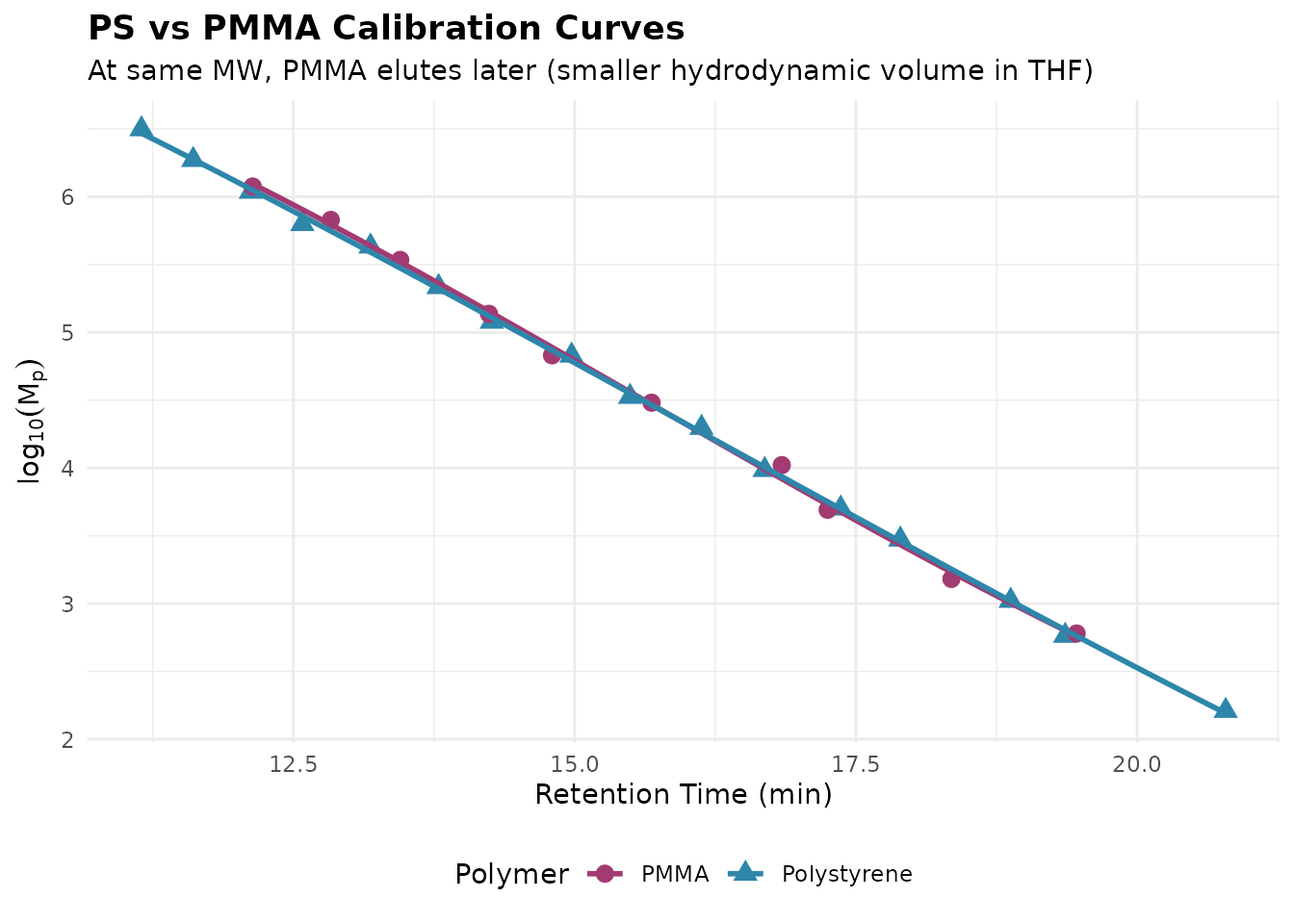
Key insight: Using a PS calibration for PMMA samples will underestimate molecular weight. For cross-polymer analysis, use universal calibration with Mark-Houwink parameters.
Multi-Detector SEC Workflow
For more accurate molecular weight determination, multi-detector SEC uses RI for concentration and MALS for absolute molecular weight:
# Multi-detector SEC workflow for absolute molecular weight
# Note: MALS processing requires additional detector configuration
rec_multi <- recipe(
  ri_signal + uv_signal + mals_signal + elution_time + dn_dc + extinction_coef ~ sample_id,
  data = sec_triple_detect
) |>
  update_role(sample_id, new_role = "id") |>
  # Convert each detector to measure format
  step_measure_input_long(
    ri_signal,
    location = vars(elution_time),
    col_name = "ri"
  ) |>
  step_measure_input_long(
    uv_signal,
    location = vars(elution_time),
    col_name = "uv"
  ) |>
  step_measure_input_long(
    mals_signal,
    location = vars(elution_time),
    col_name = "mals"
  ) |>
  # Correct inter-detector delays
  step_sec_detector_delay(
    reference = "ri",
    delay_volumes = c(uv = -0.05, mals = 0.10)
  ) |>
  # Apply baseline correction
  step_sec_baseline(measures = c("ri", "uv", "mals")) |>
  # Process detectors
  step_sec_ri(measures = "ri", dn_dc_column = "dn_dc") |>
  step_sec_uv(measures = "uv", extinction_column = "extinction_coef") |>
  step_sec_mals(mals_col = "mals", dn_dc_column = "dn_dc") |>
  # Convert to concentration (requires injection info)
  step_sec_concentration(
    measures = "ri",
    detector = "ri",
    injection_volume = 100,       # µL
    sample_concentration = 2.0    # mg/mL
  )

prepped_multi <- prep(rec_multi)
result_multi <- bake(prepped_multi, new_data = NULL)

# View multi-detector results
result_multi |>
  select(sample_id, ri, uv, mals) |>
  head(3)
#> # A tibble: 3 × 4
#>   sample_id          ri          uv        mals
#>   <chr>          <meas>      <meas>      <meas>
#> 1 PS-1K     [2,001 × 2] [2,001 × 2] [2,001 × 2]
#> 2 PS-10K    [2,001 × 2] [2,001 × 2] [2,001 × 2]
#> 3 PS-50K    [2,001 × 2] [2,001 × 2] [2,001 × 2]
Copolymer Composition Analysis
The UV/RI ratio can reveal compositional heterogeneity across the molecular weight distribution:
# Filter to copolymer samples
copolymers <- sec_triple_detect |>
  filter(polymer_type == "copolymer")

rec_comp <- recipe(
  ri_signal + uv_signal + elution_time ~ sample_id,
  data = copolymers
) |>
  update_role(sample_id, new_role = "id") |>
  step_measure_input_long(ri_signal, location = vars(elution_time), col_name = "ri") |>
  step_measure_input_long(uv_signal, location = vars(elution_time), col_name = "uv") |>
  step_sec_baseline(measures = c("ri", "uv")) |>
  # Calculate UV/RI ratio
  step_sec_uv_ri_ratio(uv_col = "uv", ri_col = "ri", smooth = TRUE) |>
  # Calculate composition (requires known response factors)
  step_sec_composition(
    uv_col = "uv",
    ri_col = "ri",
    component_a_uv = 1.0,   # UV response factor for component A
    component_a_ri = 0.185, # RI response factor for component A
    component_b_uv = 0.1,   # UV response factor for component B
    component_b_ri = 0.084  # RI response factor for component B
  )

prepped_comp <- prep(rec_comp)
result_comp <- bake(prepped_comp, new_data = NULL)

# The result contains:
# - uv_ri_ratio: Point-by-point UV/RI ratio
# - composition_a: Weight fraction of component A at each point
Protein SEC: Aggregate Quantitation
For protein therapeutics, SEC is used to quantify high molecular weight species (HMWS/aggregates) and low molecular weight species (LMWS/fragments):
# Create protein-like data (using UV at 280 nm)
# Filter to a single sample for demonstration
protein_data <- sec_triple_detect |>
  filter(sample_type == "sample") |>
  filter(sample_id == first(sample_id))

rec_protein <- recipe(
  uv_signal + elution_time ~ sample_id,
  data = protein_data
) |>
  update_role(sample_id, new_role = "id") |>
  step_measure_input_long(uv_signal, location = vars(elution_time), col_name = "uv") |>
  step_sec_baseline(measures = "uv") |>
  # Quantify aggregates with manual peak boundaries
  step_sec_aggregates(
    measures = "uv",
    monomer_start = 10,  # Monomer peak start time
    monomer_end = 14,    # Monomer peak end time
    method = "manual"
  )

prepped_protein <- prep(rec_protein)
result_protein <- bake(prepped_protein, new_data = NULL)

# Results include:
# - purity_hmws: % high MW species (before monomer)
# - purity_monomer: % main peak
# - purity_lmws: % low MW species (after monomer)
result_protein |>
  select(sample_id, purity_hmws, purity_monomer, purity_lmws)
#> # A tibble: 1 × 4
#>   sample_id purity_hmws purity_monomer purity_lmws
#>   <chr>           <dbl>          <dbl>       <dbl>
#> 1 PMMA-Low         2.05           25.7        72.1
Molecular Weight Distribution
Generate differential and cumulative molecular weight distributions:
rec_mwd <- recipe(
  ri_signal + elution_time + dn_dc + known_mw ~ sample_id,
  data = sec_triple_detect
) |>
  update_role(sample_id, new_role = "id") |>
  step_measure_input_long(ri_signal, location = vars(elution_time), col_name = "ri") |>
  step_sec_baseline(measures = "ri") |>
  step_sec_ri(measures = "ri", dn_dc_column = "dn_dc") |>
  # Add MW distribution curves
  step_sec_mw_distribution(
    measures = "ri",
    type = "both",  # "differential", "cumulative", or "both"
    calibration = NULL  # Assumes x-axis is already log10(MW)
  )

prepped_mwd <- prep(rec_mwd)
result_mwd <- bake(prepped_mwd, new_data = NULL)

# The result contains:
# - mwd_differential: dw/d(logM) vs logM
# - mwd_cumulative: cumulative weight fraction vs logM
Quality Control Functions
The package provides functions for chromatographic system suitability testing:
Peak Resolution
# Calculate USP resolution between two peaks
Rs <- measure_sec_resolution(
  retention_1 = 8.5,
  retention_2 = 10.0,
  width_1 = 0.3,
  width_2 = 0.35,
  method = "usp"
)

cat("Resolution (Rs):", round(Rs, 2), "\n")
#> Resolution (Rs): 4.62
Plate Count
# Calculate theoretical plates
N <- measure_sec_plate_count(
  retention = 10.0,
  width = 0.25,
  width_type = "half_height"
)

cat("Theoretical plates:", round(N), "\n")
#> Theoretical plates: 8864
System Suitability
# Comprehensive system suitability testing
peaks <- data.frame(
  name = c("dimer", "monomer"),
  retention = c(8.5, 10.0),
  width = c(0.3, 0.35),
  area = c(5, 95)
)

sst <- measure_sec_suitability(
  peaks = peaks,
  reference_peaks = c("dimer", "monomer")
)

print(sst)
#> SEC System Suitability Test
#> ==================================================
#>
#> Overall Status: FAILED
#>
#> Results:
#> --------------------------------------------------
#> resolution          : 4.615385 (>= 1.5) [PASS]
#> plate count         : 4522.0 (>= 5000) [FAIL]
#> --------------------------------------------------
Polymer Analysis: Mark-Houwink Parameters
Estimate Mark-Houwink parameters from intrinsic viscosity data:
# Molecular weight and intrinsic viscosity data
mw <- c(10000, 25000, 50000, 100000, 250000)
iv <- 0.0001 * mw^0.7  # Simulated data

mh <- measure_mh_parameters(mw, iv)
#> Warning in summary.lm(fit): essentially perfect fit: summary may be unreliable
print(mh)
#> Mark-Houwink Parameters
#> ========================================
#>
#> K = 1.0000e-04
#> a = 0.700
#>
#> R-squared: 1.0000
#> Data points: 5
#> MW range: 10000 - 250000
#>
#> Equation: [eta] = K * M^a
Branching Analysis
Calculate branching indices for branched polymers:
# Compare branched polymer to linear reference
mw <- c(100000, 200000, 500000)
rg_branched <- c(10, 15, 25)
rg_linear <- c(12, 18, 32)

g <- measure_branching_index(
  mw = mw,
  rg = rg_branched,
  reference = data.frame(mw = mw, rg = rg_linear),
  method = "g"
)

print(g)
#> Branching Analysis Results
#> ==================================================
#>
#> MW Range: 100000 - 500000
#> g (Rg ratio): 0.610 - 0.694 (mean: 0.666)
#>
#> Estimated branches/molecule: 2.1 - 2.7
#>
#> # A tibble: 3 × 2
#>       mw     g
#>    <dbl> <dbl>
#> 1 100000 0.694
#> 2 200000 0.694
#> 3 500000 0.610
# g < 1 indicates branching (smaller Rg than linear)
Exporting Results
Slice-by-Slice Data
Extract point-by-point chromatographic data:
# Extract point-by-point data from the processed result
slices <- measure_sec_slice_table(
  result,
  measures = "ri",
  sample_id = "sample_id",
  pivot = TRUE
)

head(slices)
#> # A tibble: 6 × 4
#>   sample_id slice location      ri
#>   <chr>     <int>    <dbl>   <dbl>
#> 1 PS-50K        1     5    0.00143
#> 2 PS-50K        2     5.01 0.00167
#> 3 PS-50K        3     5.02 0.00136
#> 4 PS-50K        4     5.03 0.00132
#> 5 PS-50K        5     5.04 0.00213
#> 6 PS-50K        6     5.05 0.00174
Summary Table
Generate a summary table for reporting:
# Generate a summary table with key metrics
summary_tbl <- measure_sec_summary_table(
  result,
  sample_id = "sample_id",
  digits = 0
)

print(summary_tbl)
#> SEC Analysis Summary
#> ============================================================
#> Samples: 1
#>
#> # A tibble: 1 × 5
#>   sample_id     mw_mn   mw_mw   mw_mz mw_dispersity
#>   <chr>         <dbl>   <dbl>   <dbl>         <dbl>
#> 1 PS-50K    419927756 8.24e21 7.81e23       1.96e13
Complete Workflow Example
Here’s a complete workflow for analyzing polymer standards:
# Complete multi-detector SEC workflow
# Note: This example demonstrates the full processing pipeline

# Create comprehensive recipe with explicit formula
rec_complete <- recipe(
  ri_signal + uv_signal + mals_signal + elution_time + dn_dc + extinction_coef + polymer_type ~ sample_id,
  data = sec_triple_detect
) |>
  update_role(sample_id, new_role = "id") |>
  # Input conversion - all three detectors
  step_measure_input_long(ri_signal, location = vars(elution_time), col_name = "ri") |>
  step_measure_input_long(uv_signal, location = vars(elution_time), col_name = "uv") |>
  step_measure_input_long(mals_signal, location = vars(elution_time), col_name = "mals") |>
  # Preprocessing
  step_sec_detector_delay(reference = "ri", delay_volumes = c(uv = -0.05, mals = 0.10)) |>
  step_sec_baseline(measures = c("ri", "uv", "mals")) |>
  # Detector processing
  step_sec_ri(measures = "ri", dn_dc_column = "dn_dc") |>
  step_sec_uv(measures = "uv", extinction_column = "extinction_coef") |>
  step_sec_mals(mals_col = "mals", dn_dc_column = "dn_dc") |>
  step_sec_concentration(
    measures = "ri",
    detector = "ri",
    injection_volume = 100,
    sample_concentration = 2.0
  ) |>
  # Composition analysis
  step_sec_uv_ri_ratio(uv_col = "uv", ri_col = "ri")

# Process
prepped_complete <- prep(rec_complete)
result_complete <- bake(prepped_complete, new_data = NULL)

# View processed results
result_complete |>
  select(sample_id, polymer_type, ri, uv, mals) |>
  head(6)
#> # A tibble: 6 × 5
#>   sample_id polymer_type          ri          uv        mals
#>   <chr>     <fct>             <meas>      <meas>      <meas>
#> 1 PS-1K     polystyrene  [2,001 × 2] [2,001 × 2] [2,001 × 2]
#> 2 PS-10K    polystyrene  [2,001 × 2] [2,001 × 2] [2,001 × 2]
#> 3 PS-50K    polystyrene  [2,001 × 2] [2,001 × 2] [2,001 × 2]
#> 4 PS-100K   polystyrene  [2,001 × 2] [2,001 × 2] [2,001 × 2]
#> 5 PS-500K   polystyrene  [2,001 × 2] [2,001 × 2] [2,001 × 2]
#> 6 PMMA-Low  pmma         [2,001 × 2] [2,001 × 2] [2,001 × 2]
Available Steps Reference
Preprocessing Steps
| Step | Key Parameters | Description |
|---|---|---|
step_sec_detector_delay() |
reference, delay_volumes
|
Align multi-detector signals by correcting inter-detector volume delays |
step_sec_baseline() |
measures, method, points
|
Remove baseline drift; methods: "linear",
"polynomial", "spline"
|
Detector Steps
| Step | Key Parameters | Description |
|---|---|---|
step_sec_ri() |
measures, dn_dc_column
|
Process RI signal; requires dn/dc for concentration |
step_sec_uv() |
measures, extinction_column,
wavelength
|
Process UV signal with extinction coefficient |
step_sec_dad() |
measures, wavelengths
|
Multi-wavelength diode array detection |
step_sec_mals() |
mals_col, dn_dc_column,
wavelength
|
Multi-angle light scattering for Mw and Rg |
step_sec_lals() |
lals_col, dn_dc_column
|
Low-angle LS for Mw without extrapolation |
step_sec_rals() |
rals_col, dn_dc_column
|
Right-angle LS (90°) |
step_sec_dls() |
dls_col |
Dynamic LS for hydrodynamic radius |
step_sec_viscometer() |
visc_col, dp_column
|
Differential viscometer for intrinsic viscosity |
Calibration Steps
| Step | Key Parameters | Description |
|---|---|---|
step_sec_conventional_cal() |
standards, fit_type,
extrapolation
|
Narrow standard calibration (polymer-specific) |
step_sec_universal_cal() |
standards, k, alpha
|
Universal calibration with Mark-Houwink parameters |
Calculation Steps
| Step | Key Parameters | Outputs |
|---|---|---|
step_sec_concentration() |
injection_volume,
sample_concentration
|
Absolute concentration (mg/mL) |
step_sec_intrinsic_visc() |
concentration_col, viscosity_col
|
[η] at each slice |
step_sec_mw_averages() |
measures |
mw_mn, mw_mw, mw_mz,
mw_dispersity
|
step_sec_mw_fractions() |
cutoffs |
Weight fractions above/below MW cutoffs |
step_sec_mw_distribution() |
type |
Differential and/or cumulative MWD curves |
Composition Steps
| Step | Key Parameters | Outputs |
|---|---|---|
step_sec_uv_ri_ratio() |
uv_col, ri_col, smooth
|
Point-by-point UV/RI ratio |
step_sec_composition() |
component_a_uv, component_a_ri, … |
Weight fraction of each component |
step_sec_aggregates() |
monomer_start, monomer_end,
method
|
purity_hmws, purity_monomer,
purity_lmws
|
See Also
For focused how-to guides on specific workflows:
- Getting Started - Introduction and basic workflow
- Multi-Detector SEC - MALS, viscometer, and absolute MW
- Protein SEC Analysis - Biopharm aggregate/fragment analysis
- Copolymer Composition - UV/RI ratio methods
- Calibration Management - Save/load calibrations
- System Suitability - QC metrics and SST
Session Info
sessionInfo()
#> R version 4.5.2 (2025-10-31)
#> Platform: x86_64-pc-linux-gnu
#> Running under: Ubuntu 24.04.3 LTS
#>
#> Matrix products: default
#> BLAS:   /usr/lib/x86_64-linux-gnu/openblas-pthread/libblas.so.3
#> LAPACK: /usr/lib/x86_64-linux-gnu/openblas-pthread/libopenblasp-r0.3.26.so;  LAPACK version 3.12.0
#>
#> locale:
#>  [1] LC_CTYPE=C.UTF-8       LC_NUMERIC=C           LC_TIME=C.UTF-8
#>  [4] LC_COLLATE=C.UTF-8     LC_MONETARY=C.UTF-8    LC_MESSAGES=C.UTF-8
#>  [7] LC_PAPER=C.UTF-8       LC_NAME=C              LC_ADDRESS=C
#> [10] LC_TELEPHONE=C         LC_MEASUREMENT=C.UTF-8 LC_IDENTIFICATION=C
#>
#> time zone: UTC
#> tzcode source: system (glibc)
#>
#> attached base packages:
#> [1] stats     graphics  grDevices utils     datasets  methods   base
#>
#> other attached packages:
#> [1] ggplot2_4.0.1          purrr_1.2.1            tidyr_1.3.2
#> [4] measure.sec_0.0.0.9000 measure_0.0.1.9002     recipes_1.3.1
#> [7] dplyr_1.1.4
#>
#> loaded via a namespace (and not attached):
#>  [1] gtable_0.3.6        xfun_0.56           bslib_0.10.0
#>  [4] lattice_0.22-7      vctrs_0.7.1         tools_4.5.2
#>  [7] generics_0.1.4      parallel_4.5.2      tibble_3.3.1
#> [10] pkgconfig_2.0.3     Matrix_1.7-4        data.table_1.18.2.1
#> [13] RColorBrewer_1.1-3  S7_0.2.1            desc_1.4.3
#> [16] lifecycle_1.0.5     compiler_4.5.2      farver_2.1.2
#> [19] textshaping_1.0.4   codetools_0.2-20    htmltools_0.5.9
#> [22] class_7.3-23        sass_0.4.10         yaml_2.3.12
#> [25] prodlim_2025.04.28  pillar_1.11.1       pkgdown_2.2.0
#> [28] jquerylib_0.1.4     MASS_7.3-65         cachem_1.1.0
#> [31] gower_1.0.2         rpart_4.1.24        nlme_3.1-168
#> [34] parallelly_1.46.1   lava_1.8.2          tidyselect_1.2.1
#> [37] digest_0.6.39       future_1.69.0       listenv_0.10.0
#> [40] labeling_0.4.3      splines_4.5.2       fastmap_1.2.0
#> [43] grid_4.5.2          cli_3.6.5           magrittr_2.0.4
#> [46] utf8_1.2.6          survival_3.8-3      future.apply_1.20.1
#> [49] withr_3.0.2         scales_1.4.0        lubridate_1.9.4
#> [52] timechange_0.4.0    rmarkdown_2.30      globals_0.19.0
#> [55] nnet_7.3-20         timeDate_4052.112   ragg_1.5.0
#> [58] evaluate_1.0.5      knitr_1.51          hardhat_1.4.2
#> [61] mgcv_1.9-3          rlang_1.1.7         Rcpp_1.1.1
#> [64] glue_1.8.0          ipred_0.9-15        jsonlite_2.0.0
#> [67] R6_2.6.1            systemfonts_1.3.1   fs_1.6.6