
Overview
This guide shows you how to save, load, and reuse SEC calibrations with measure.sec. Key tasks covered:
- Save a calibration from a prepped recipe
- Load and reuse a saved calibration
- Inspect calibration quality
- Compare calibrations over time
Setup
library(measure)
#> Loading required package: recipes
#> Loading required package: dplyr
#>
#> Attaching package: 'dplyr'
#> The following objects are masked from 'package:stats':
#>
#>     filter, lag
#> The following objects are masked from 'package:base':
#>
#>     intersect, setdiff, setequal, union
#>
#> Attaching package: 'recipes'
#> The following object is masked from 'package:stats':
#>
#>     step
library(measure.sec)
library(recipes)
library(dplyr)
library(ggplot2)
How to Create and Save a Calibration
Step 1: Fit a Calibration
First, create a recipe with calibration standards and prep it to fit the calibration:
# Load polystyrene standards
data(sec_ps_standards)

# View the standards
sec_ps_standards |>
  select(standard_name, mp, log_mp, retention_time) |>
  head(8)
#> # A tibble: 8 × 4
#>   standard_name      mp log_mp retention_time
#>   <chr>           <dbl>  <dbl>          <dbl>
#> 1 PS-3150000    3150000   6.50           11.2
#> 2 PS-1870000    1870000   6.27           11.6
#> 3 PS-1090000    1090000   6.04           12.1
#> 4 PS-630000      630000   5.80           12.6
#> 5 PS-430000      430000   5.63           13.2
#> 6 PS-216000      216000   5.33           13.8
#> 7 PS-120000      120000   5.08           14.3
#> 8 PS-67500        67500   4.83           15.0
# Prepare standards with required column names
# The step expects 'retention' and 'log_mw' columns
ps_cal_standards <- sec_ps_standards |>
  select(retention = retention_time, log_mw = log_mp)

# Create a simple data frame for the recipe
# (In practice, this would be your chromatogram data)
sample_data <- tibble(
  sample_id = "test",
  elution_time = seq(10, 20, by = 0.01),
  ri_signal = dnorm(seq(10, 20, by = 0.01), mean = 14, sd = 1)
)

# Create and prep a recipe with conventional calibration
rec <- recipe(~ ., data = sample_data) |>
  step_measure_input_long(
    ri_signal,
    location = vars(elution_time),
    col_name = "ri"
  ) |>
  step_sec_conventional_cal(
    standards = ps_cal_standards,
    fit_type = "cubic"
  )

# Prep the recipe (this fits the calibration)
prepped <- prep(rec)
#> Warning: Standard at 12.58 has 14.4% MW deviation.
#> ℹ Consider removing outlier standards or using a different fit type.
#> Warning: 115 points (11.5%) are outside calibration range.
#> ℹ Calibration range: 11.15 to 20.79
Step 2: Save the Calibration
Use save_sec_calibration() to extract and save the
calibration for reuse:
# Create a temporary file for this example
cal_file <- tempfile(fileext = ".rds")

# Save with metadata for traceability
save_sec_calibration(
 prepped,
  cal_file,
  metadata = list(
    column = "PLgel 5um Mixed-C",
    instrument = "Agilent 1260",
    analyst = "JW",
    notes = "Monthly calibration - January 2024"
  )
)
#> ✔ Saved cubic calibration to /tmp/RtmpnCnUxt/file284c38a1b389.rds
Format Options
Two formats are supported:
| Format | Extension | Best For |
|---|---|---|
| RDS | .rds |
Default. Preserves all R objects exactly |
| YAML | .yaml |
Human-readable, good for version control |
# Save as YAML for human readability
save_sec_calibration(prepped, "calibration.yaml")
How to Load and Reuse a Calibration
Load a Saved Calibration
# Load the calibration
cal <- load_sec_calibration(cal_file)
#> ℹ Loaded cubic calibration (R\u00b2 = 0.9995)

# View calibration details
print(cal)
#>
#> ── SEC Calibration ─────────────────────────────────────────────────────────────
#> Fit type: cubic (degree 3)
#> Calibration range: 11.15 to 20.79
#> Standards: 16
#>
#> ── Fit Quality ──
#>
#> R\u00b2: 0.999466
#> RMSE (log MW): 0.0294
#> Max % deviation: 14.43%
#>
#> ── Settings ──
#>
#> Extrapolation: warn
#> Output column: mw
#> Log output: TRUE
#>
#> ── Metadata ──
#>
#> Created: 2026-02-02 17:16:55
#> measure.sec version: 0.0.0.9000
#>
#> ── User Metadata
#> column: PLgel 5um Mixed-C
#> instrument: Agilent 1260
#> analyst: JW
#> notes: Monthly calibration - January 2024
Use in a New Recipe
Pass the loaded calibration to
step_sec_conventional_cal() to skip fitting:
# New sample data
new_samples <- tibble(
  sample_id = "unknown_polymer",
  elution_time = seq(10, 20, by = 0.01),
  ri_signal = dnorm(seq(10, 20, by = 0.01), mean = 15, sd = 0.8)
)

# Create recipe using saved calibration (no fitting needed)
rec_new <- recipe(~ ., data = new_samples) |>
  step_measure_input_long(
    ri_signal,
    location = vars(elution_time),
    col_name = "ri"
  ) |>
  step_sec_conventional_cal(calibration = cal)

# Prep and bake
prepped_new <- prep(rec_new)
#> ℹ Using pre-loaded cubic calibration (R\u00b2 = 0.9995)
#> Warning: 115 points (11.5%) are outside calibration range.
#> ℹ Calibration range: 11.15 to 20.79
result <- bake(prepped_new, new_data = NULL)
How to Inspect Calibration Quality
View Fit Diagnostics
# Summary shows per-standard results
summary(cal)
#>
#> ── SEC Calibration ─────────────────────────────────────────────────────────────
#> Fit type: cubic (degree 3)
#> Calibration range: 11.15 to 20.79
#> Standards: 16
#>
#> ── Fit Quality ──
#>
#> R\u00b2: 0.999466
#> RMSE (log MW): 0.0294
#> Max % deviation: 14.43%
#>
#> ── Settings ──
#>
#> Extrapolation: warn
#> Output column: mw
#> Log output: TRUE
#>
#> ── Metadata ──
#>
#> Created: 2026-02-02 17:16:55
#> measure.sec version: 0.0.0.9000
#>
#> ── User Metadata
#> column: PLgel 5um Mixed-C
#> instrument: Agilent 1260
#> analyst: JW
#> notes: Monthly calibration - January 2024
#>
#> ── Per-Standard Results ──
#>
#> # A tibble: 16 × 10
#>    location actual_log_mw predicted_log_mw residual_log_mw actual_mw
#>       <dbl>         <dbl>            <dbl>           <dbl>     <dbl>
#>  1     11.2          6.50             6.47         0.0294   3150000.
#>  2     11.6          6.27             6.28        -0.00364  1870000.
#>  3     12.1          6.04             6.06        -0.0192   1090000
#>  4     12.6          5.80             5.86        -0.0585    630000.
#>  5     13.2          5.63             5.59         0.0421    430000.
#>  6     13.8          5.33             5.32         0.0126    216000
#>  7     14.3          5.08             5.11        -0.0300    120000.
#>  8     15.0          4.83             4.79         0.0413     67500.
#>  9     15.5          4.53             4.55        -0.0262     33500.
#> 10     16.1          4.30             4.26         0.0352     19800
#> 11     16.7          3.99             4.01        -0.0197      9680
#> 12     17.4          3.70             3.70         0.00359     5030
#> 13     17.9          3.47             3.46         0.0146      2970
#> 14     18.9          3.02             3.02         0.00222     1050
#> 15     19.4          2.76             2.81        -0.0419       580
#> 16     20.8          2.21             2.19         0.0181       162
#> # ℹ 5 more variables: predicted_mw <dbl>, pct_deviation <dbl>,
#> #   prediction_se <dbl>, ci_lower_log_mw <dbl>, ci_upper_log_mw <dbl>
Key Quality Metrics
| Metric | Good Value | Meaning |
|---|---|---|
| R² | > 0.999 | Fit explains variance |
| RMSE (log MW) | < 0.05 | Prediction error in log units |
| Max % deviation | < 5% | Worst individual standard |
Visualize the Calibration Curve
# Plot calibration curve from standards data
plot_sec_calibration(sec_ps_standards)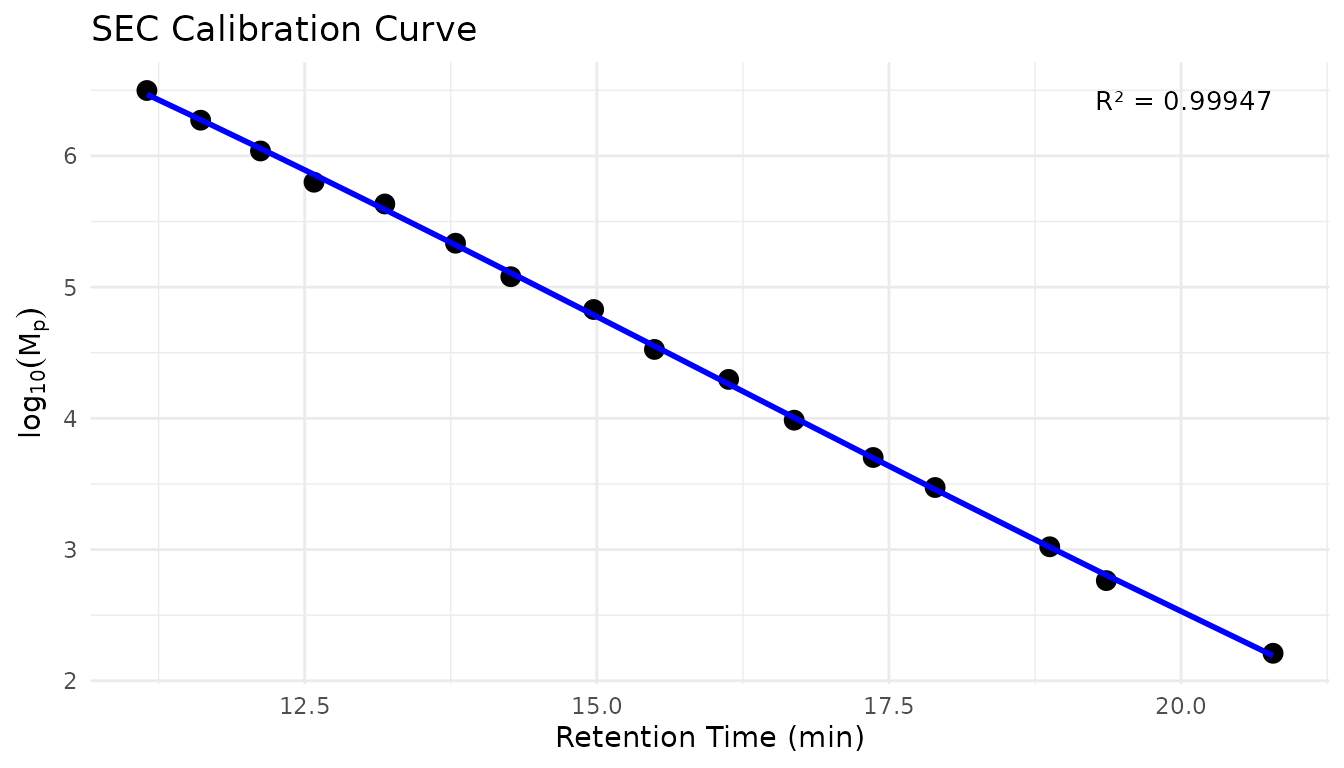
# With residuals panel to check for systematic errors
plot_sec_calibration(sec_ps_standards, show_residuals = TRUE)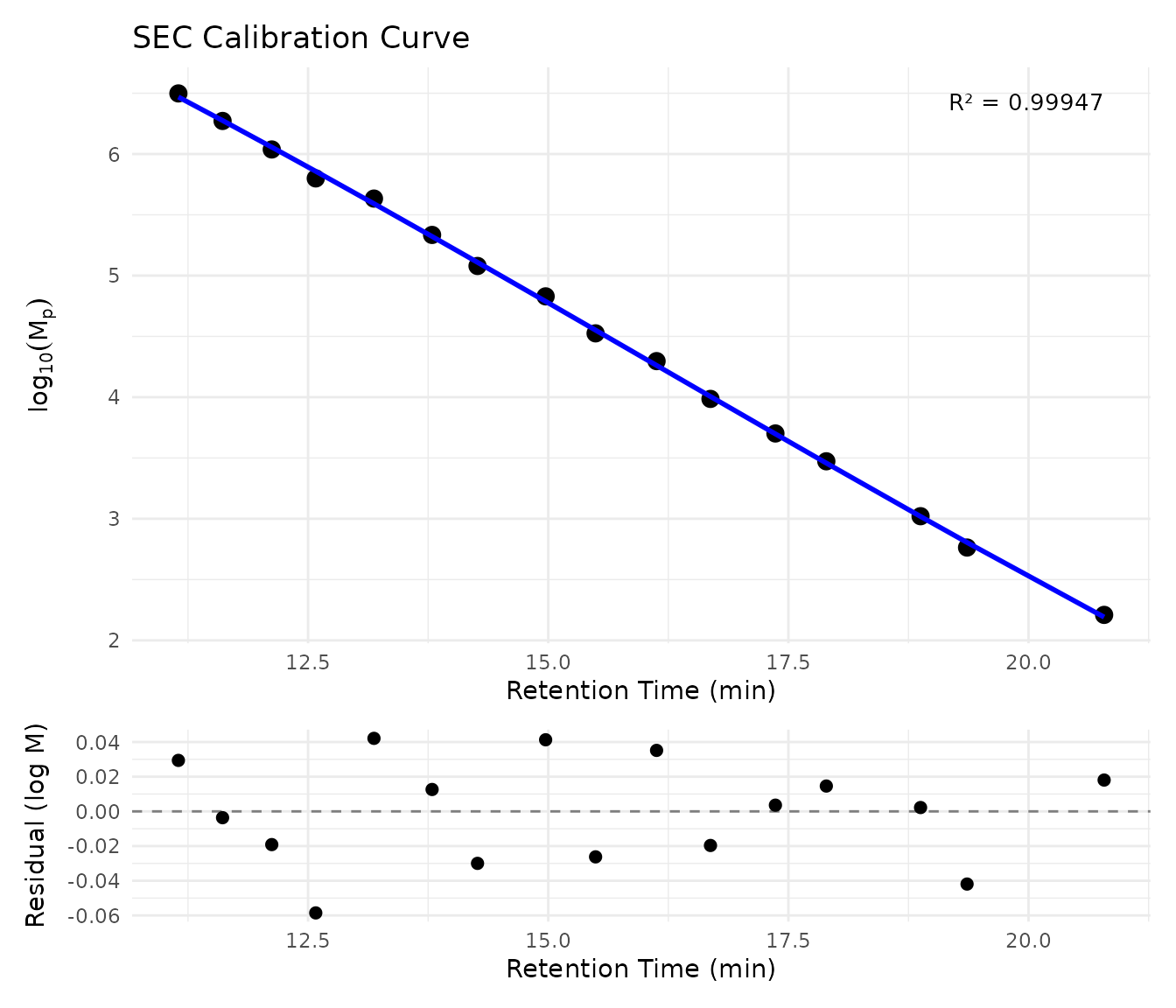
When to Recalibrate vs. Reuse
Best Practices
Naming Conventions
Use descriptive, consistent file names:
# Good: includes key information
"ps_plgel-mixed-c_2024-01-15.rds"
"pmma_superose6_instrument2_2024-01.yaml"

# Avoid: ambiguous names
"calibration.rds"
"cal_new.rds"
Include Metadata
Always add metadata for traceability:
save_sec_calibration(
  prepped,
  "ps_calibration.rds",
  metadata = list(
    column = "PLgel 5um Mixed-C, S/N ABC123",
    instrument = "Agilent 1260 #2",
    analyst = "Jane Doe",
    date = Sys.Date(),
    mobile_phase = "THF + 0.1% BHT",
    flow_rate = "1.0 mL/min",
    temperature = "35C",
    notes = "Monthly recalibration after column flush"
  )
)
Version Control (YAML Format)
For labs using git or similar version control:
# YAML format is diff-friendly
save_sec_calibration(prepped, "calibrations/ps_current.yaml")

# Git will show meaningful diffs when calibration changes
Lab Workflow Integration
A typical workflow:
- Monthly: Run calibration standards, save new calibration with date
- Daily: Load current calibration for sample analysis
- Archive: Keep old calibrations for historical reference
- Compare: Periodically compare calibrations to detect drift
# Monthly calibration routine
monthly_cal <- prep(calibration_recipe)
save_sec_calibration(
  monthly_cal,
  sprintf("calibrations/ps_%s.rds", format(Sys.Date(), "%Y-%m")),
  metadata = list(analyst = Sys.info()["user"])
)

# Daily sample analysis
cal <- load_sec_calibration("calibrations/ps_2024-01.rds")
samples_recipe <- recipe(...) |>
  step_sec_conventional_cal(calibration = cal) |>
  prep()
Cleanup
# Remove temporary file
unlink(cal_file)
See Also
- Getting Started - Basic SEC workflow and concepts
- System Suitability - Validate column performance
- Multi-Detector SEC - Absolute MW without calibration
- Exporting Results - Summary tables and reports
Session Info
sessionInfo()
#> R version 4.5.2 (2025-10-31)
#> Platform: x86_64-pc-linux-gnu
#> Running under: Ubuntu 24.04.3 LTS
#>
#> Matrix products: default
#> BLAS:   /usr/lib/x86_64-linux-gnu/openblas-pthread/libblas.so.3
#> LAPACK: /usr/lib/x86_64-linux-gnu/openblas-pthread/libopenblasp-r0.3.26.so;  LAPACK version 3.12.0
#>
#> locale:
#>  [1] LC_CTYPE=C.UTF-8       LC_NUMERIC=C           LC_TIME=C.UTF-8
#>  [4] LC_COLLATE=C.UTF-8     LC_MONETARY=C.UTF-8    LC_MESSAGES=C.UTF-8
#>  [7] LC_PAPER=C.UTF-8       LC_NAME=C              LC_ADDRESS=C
#> [10] LC_TELEPHONE=C         LC_MEASUREMENT=C.UTF-8 LC_IDENTIFICATION=C
#>
#> time zone: UTC
#> tzcode source: system (glibc)
#>
#> attached base packages:
#> [1] stats     graphics  grDevices utils     datasets  methods   base
#>
#> other attached packages:
#> [1] ggplot2_4.0.1          measure.sec_0.0.0.9000 measure_0.0.1.9002
#> [4] recipes_1.3.1          dplyr_1.1.4
#>
#> loaded via a namespace (and not attached):
#>  [1] gtable_0.3.6        xfun_0.56           bslib_0.10.0
#>  [4] lattice_0.22-7      vctrs_0.7.1         tools_4.5.2
#>  [7] generics_0.1.4      parallel_4.5.2      tibble_3.3.1
#> [10] pkgconfig_2.0.3     Matrix_1.7-4        data.table_1.18.2.1
#> [13] RColorBrewer_1.1-3  S7_0.2.1            desc_1.4.3
#> [16] lifecycle_1.0.5     compiler_4.5.2      farver_2.1.2
#> [19] textshaping_1.0.4   codetools_0.2-20    htmltools_0.5.9
#> [22] class_7.3-23        sass_0.4.10         yaml_2.3.12
#> [25] prodlim_2025.04.28  tidyr_1.3.2         pillar_1.11.1
#> [28] pkgdown_2.2.0       jquerylib_0.1.4     MASS_7.3-65
#> [31] cachem_1.1.0        gower_1.0.2         rpart_4.1.24
#> [34] parallelly_1.46.1   lava_1.8.2          tidyselect_1.2.1
#> [37] digest_0.6.39       future_1.69.0       purrr_1.2.1
#> [40] listenv_0.10.0      labeling_0.4.3      splines_4.5.2
#> [43] fastmap_1.2.0       grid_4.5.2          cli_3.6.5
#> [46] magrittr_2.0.4      patchwork_1.3.2     utf8_1.2.6
#> [49] survival_3.8-3      future.apply_1.20.1 withr_3.0.2
#> [52] scales_1.4.0        lubridate_1.9.4     timechange_0.4.0
#> [55] rmarkdown_2.30      globals_0.19.0      nnet_7.3-20
#> [58] timeDate_4052.112   ragg_1.5.0          evaluate_1.0.5
#> [61] knitr_1.51          hardhat_1.4.2       rlang_1.1.7
#> [64] Rcpp_1.1.1          glue_1.8.0          ipred_0.9-15
#> [67] jsonlite_2.0.0      R6_2.6.1            systemfonts_1.3.1
#> [70] fs_1.6.6